
Student NumPy Training
Master Numerical Python for Data Science & AI. Learn NumPy arrays, mathematical operations, indexing, broadcasting, and scientific computing with hands-on projects.
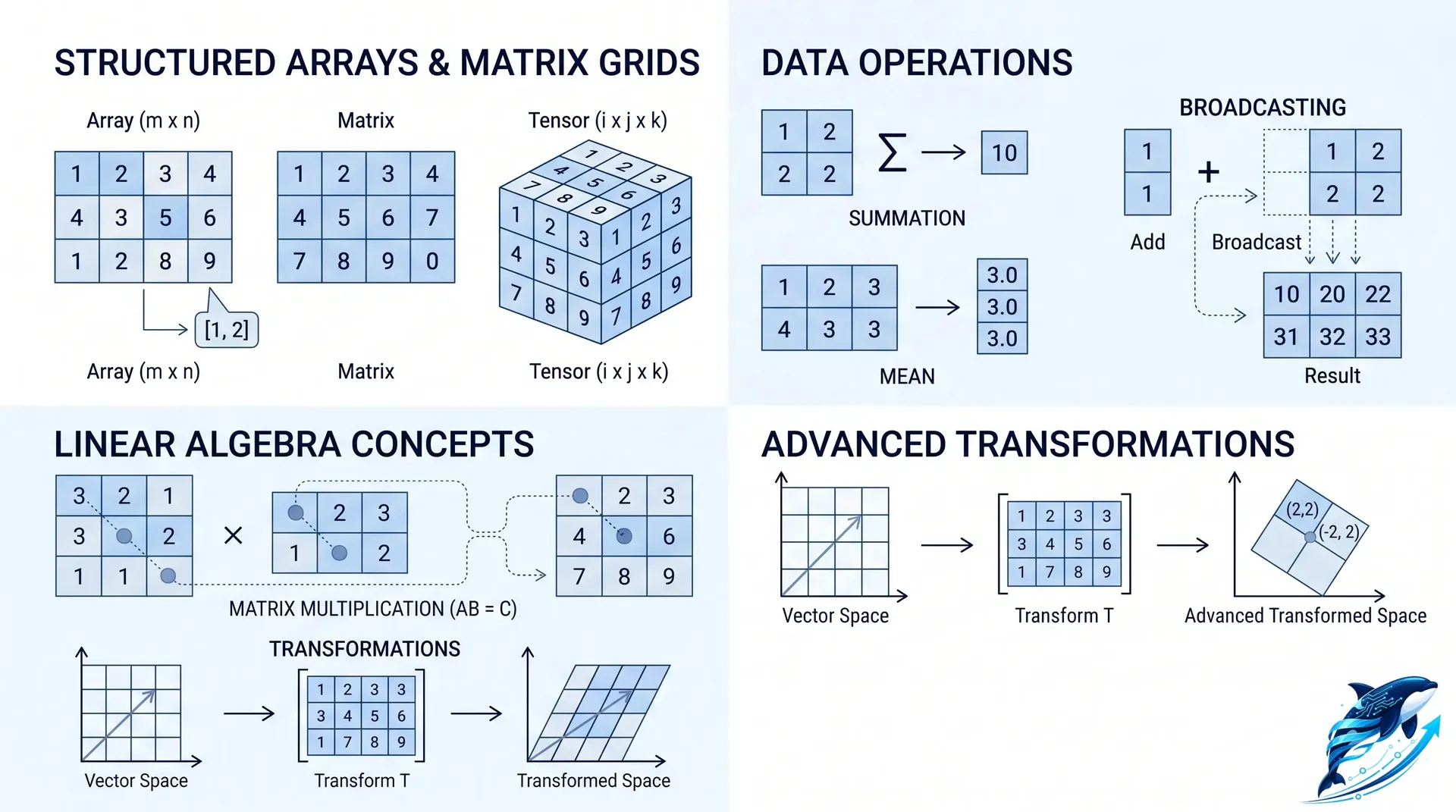
Master Numerical Computing with NumPy
NumPy (Numerical Python) is the fundamental library for scientific computing in Python. It provides powerful array objects, mathematical functions, and tools for working with large, multi-dimensional arrays and matrices. Our Student NumPy Training program is designed to help students master this essential library for data science, machine learning, and AI applications.
Based in Ahmedabad, India, our program is led by experienced data science instructors who make complex numerical concepts easy to understand. You'll learn NumPy arrays, array operations, indexing and slicing, broadcasting, mathematical functions, linear algebra, and random number generation through interactive sessions and hands-on projects. NumPy is a must-learn for any student aspiring to enter data science, AI, or scientific computing.
NumPy Training Curriculum
Module 1: Introduction to NumPy
- What is NumPy & Why Use It?
- Installing & Importing NumPy
- Creating NumPy Arrays
- Array Attributes (shape, size, dtype)
- NumPy vs Python Lists
Module 2: Array Operations
- Array Creation Methods (zeros, ones, arange, linspace)
- Reshaping & Transposing Arrays
- Stacking & Splitting Arrays
- Arithmetic Operations on Arrays
- Universal Functions (ufuncs)
Module 3: Indexing & Slicing
- Basic Indexing & Slicing
- Boolean Indexing
- Fancy Indexing
- Modifying Array Values
- Views vs Copies
Module 4: Broadcasting & Vectorization
- Understanding Broadcasting Rules
- Vectorized Operations
- Conditional Operations (where, select)
- Aggregation Functions (sum, mean, max, min)
- Performance Benefits of Vectorization
Module 5: Mathematical & Statistical Functions
- Trigonometric Functions
- Exponential & Logarithmic Functions
- Statistical Functions (mean, median, std, var)
- Sorting & Searching Arrays
- Unique Values & Set Operations
Module 6: Linear Algebra & Random Numbers
- Matrix Operations (dot, matmul)
- Determinants & Inverse
- Eigenvalues & Eigenvectors
- Random Number Generation
- NumPy Project Work
Why Students Should Learn NumPy?
Foundation for Data Science
Essential for Pandas, Scikit-learn, TensorFlow
High Performance
100x faster than Python lists
Scientific Computing
Used in research & engineering
AI/ML Prerequisite
Must-know for AI aspirants
High Demand Skill
Required for data jobs
Wide Applications
Finance, physics, image processing
Our Training Methodology
Concept Learning
Clear explanations of NumPy concepts with visual examples and real-world applications.
Live Coding Sessions
Interactive coding sessions where you write NumPy code alongside the instructor.
Hands-on Exercises
Weekly assignments and coding challenges to reinforce learning.
Project-Based Learning
Build real projects like image processing, data analysis, and scientific computing applications.