
NumPy Training Program
Master numerical computing in Python. Learn array operations, mathematical functions, broadcasting, and data manipulation with hands-on NumPy training.
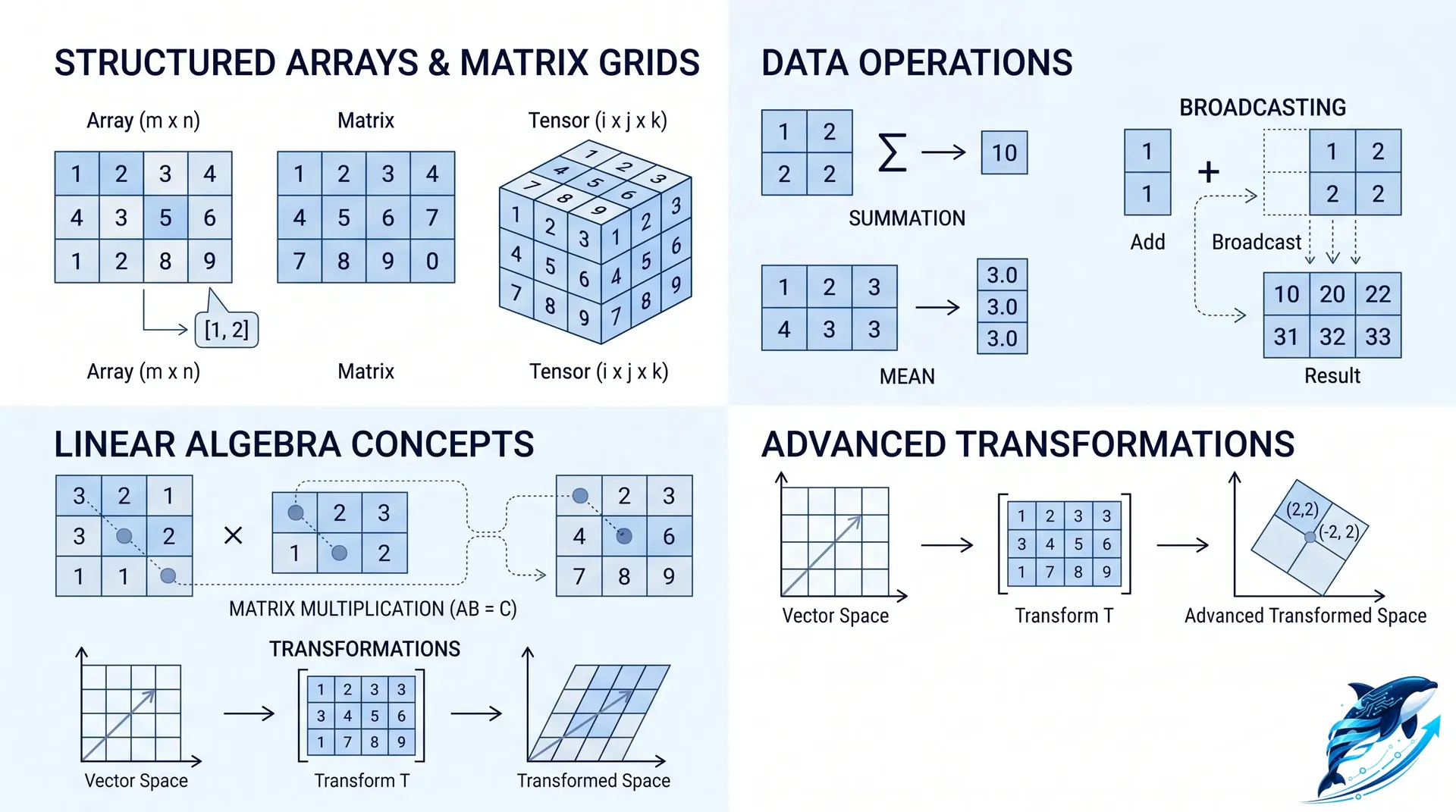
Master NumPy for Data Science & Machine Learning
NumPy (Numerical Python) is the fundamental package for scientific computing in Python. It provides powerful N-dimensional arrays, mathematical functions, linear algebra operations, and random number generation capabilities. NumPy is the foundation of nearly all data science and machine learning libraries including Pandas, SciPy, Scikit-learn, and TensorFlow.
Our NumPy training program is designed for individuals who want to master numerical computing in Python. From array creation and manipulation to advanced broadcasting and linear algebra, this course covers everything you need to efficiently work with numerical data. Perfect for data science aspirants, ML engineers, researchers, and Python developers.
Course Curriculum
Module 1: Introduction to NumPy & Arrays Session 1-2
What is NumPy? Installing NumPy, ndarrays vs Python lists, array attributes (shape, size, dtype, ndim).
Module 2: Creating Arrays Session 3-4
array(), arange(), linspace(), zeros(), ones(), eye(), random.rand(), random.randn(), and reshape().
Module 3: Array Indexing & Slicing Session 5-6
Basic indexing, slicing, fancy indexing, boolean indexing, and modifying array elements.
Module 4: Mathematical & Statistical Operations Session 7-9
Element-wise operations, universal functions (ufuncs), sum(), mean(), std(), min(), max(), cumulative operations.
Module 5: Broadcasting & Array Manipulation Session 10-12
Broadcasting rules, concatenation, stacking, splitting, transposing, and reshaping arrays.
Module 6: Linear Algebra with NumPy Session 13-14
Matrix multiplication, dot product, determinant, inverse, eigenvalues, and solving linear equations.
Module 7: Working with Data Session 15-16
Loading/saving arrays (.npy, .npz), working with CSV files, handling missing data, and structured arrays.
Module 8: Performance Optimization & Best Practices Session 17-18
Vectorization vs loops, memory optimization, using einsum(), and integration with Numba.
Module 9: Integration with Pandas & Matplotlib Session 19-20
Converting between NumPy arrays and Pandas DataFrames, visualizing array data with Matplotlib.
What You'll Learn - Code Example
import numpy as np

# Create a 2D array
arr = np.array([[1, 2, 3], [4, 5, 6], [7, 8, 9]])

# Array operations
print("Shape:", arr.shape)
print("Mean:", np.mean(arr))
print("Sum along rows:", np.sum(arr, axis=1))

# Broadcasting
arr2 = arr * 2
print("Broadcasted:\n", arr2)

# Linear algebra
dot_product = np.dot(arr, arr.T)
print("Dot product:\n", dot_product)
Hands-On Projects
Training Features
Live Instructor-Led Sessions
Interactive classes with expert instructors, real-time doubt resolution.
Hands-On Coding Exercises
40+ coding exercises and assignments to reinforce learning.
Flexible Schedule
Weekend batches, weekday batches, and self-paced options available.
Industry Certification
Get a recognized certificate upon completion of the program.