
NumPy Training for Numerical Computing
Master the foundation of scientific computing in Python. Learn to work with multidimensional arrays, mathematical functions, and high-performance numerical operations.
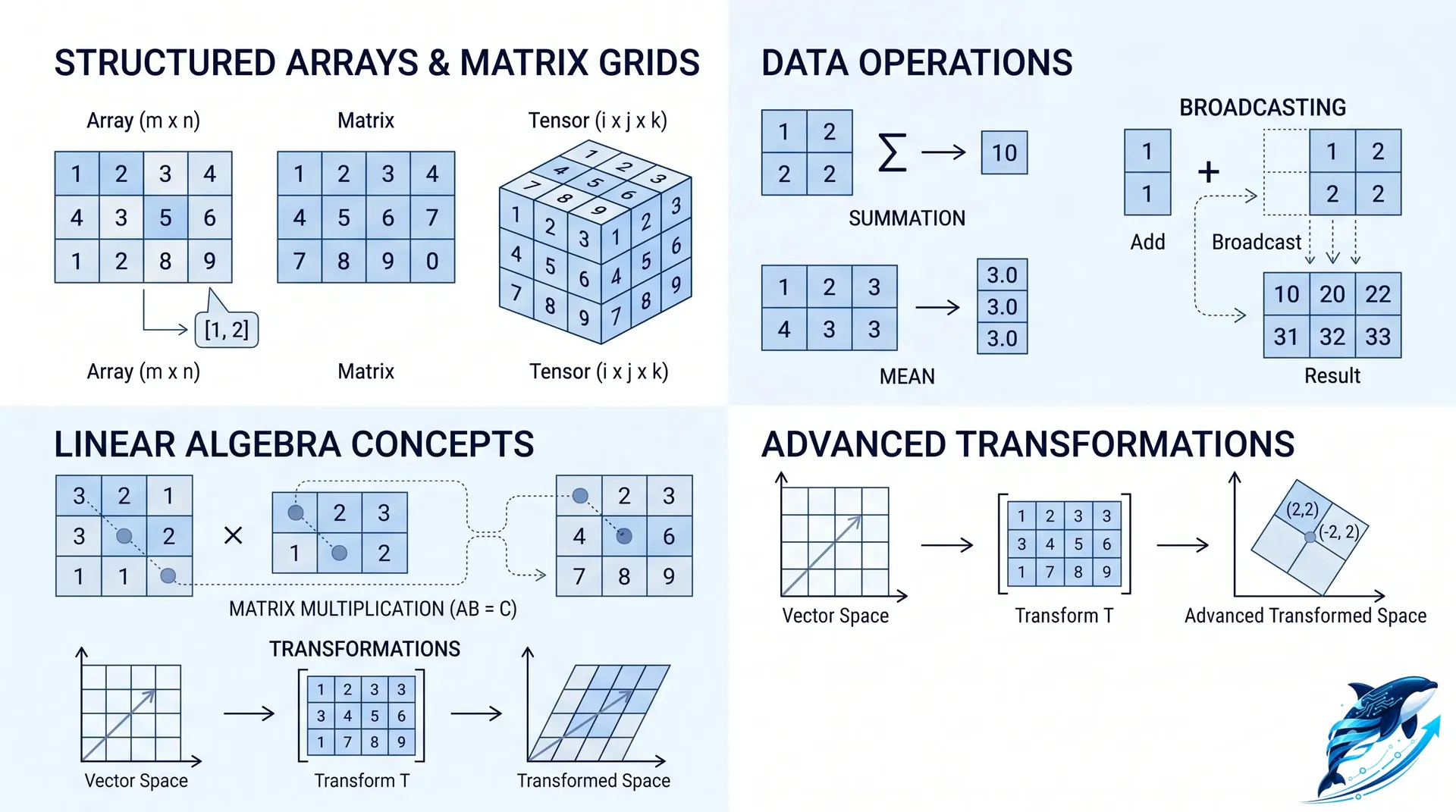
Build a Strong Foundation for Scientific Computing
NumPy (Numerical Python) is the fundamental package for scientific computing in Python. It provides powerful N-dimensional array objects, broadcasting functions, linear algebra routines, Fourier transforms, and random number generation capabilities. At OrcaMinds, our individual NumPy training program takes you from basics to advanced numerical computing with hands-on exercises, real-world applications, and expert mentorship.
We offer flexible scheduling, one-on-one attention, and practical coding exercises. Whether you are a data science aspirant, engineer, researcher, or Python developer, our NumPy course will help you master efficient numerical computations and prepare you for advanced data science and machine learning.
Course Curriculum
Module 1: Introduction to NumPy
What is NumPy? Installing NumPy, ndarray vs Python lists, array attributes (shape, size, dtype, ndim).
Module 2: Creating Arrays
Creating arrays from lists, zeros, ones, empty, arange, linspace, random arrays, identity matrix, eye function.
Module 3: Array Indexing & Slicing
Basic indexing, slicing, fancy indexing, boolean indexing, integer array indexing, modifying array elements.
Module 4: Array Operations
Arithmetic operations (+, -, *, /, **), universal functions (sin, cos, exp, log), comparison operators, logical operations.
Module 5: Array Manipulation
Reshaping, flattening, transposing, stacking (hstack, vstack, concatenate), splitting, adding/removing dimensions.
Module 6: Mathematical Functions
Statistical functions (mean, median, std, var, min, max, sum), cumulative operations, dot product, matrix multiplication.
Module 7: Broadcasting
Understanding broadcasting rules, broadcasting with scalars, broadcasting with arrays of different shapes, broadcasting limitations.
Module 8: Linear Algebra
Matrix operations, dot product, inverse, determinant, eigenvalues, solving linear equations, SVD.
Module 9: Random Number Generation
Random module, generating random numbers from distributions (uniform, normal, binomial), setting random seeds.
Module 10: Performance & Best Practices
Vectorization vs loops, memory efficiency, using NumPy with large datasets, integration with Pandas and SciPy.
Course Features
1-on-1 Training
Hands-on Exercises
Flexible Schedule
Real-world Applications
Certificate Included
Post-Training Support
Your Learning Journey
Assessment & Goal Setting
We assess your current Python knowledge and define your learning goals and timeline.
Interactive Learning Sessions
Weekly one-on-one sessions covering theory, practical coding, and problem-solving.
Hands-on Projects
Real-world numerical computing projects using NumPy for data analysis and scientific computing.
Assessment & Certification
Final project submission, assessment, and course completion certificate.
Real-World Applications of NumPy
Data Analysis
Foundation for Pandas, data cleaning, statistical analysis
Machine Learning
Feature matrices, model parameters, gradient computations
Image Processing
Images as NumPy arrays, pixel manipulation, filters
Signal Processing
Audio processing, Fourier transforms, filtering