
Student C Programming Training
Build a strong foundation in programming with our comprehensive C language course designed specifically for college students. Learn C fundamentals, pointers, data structures, and algorithms with hands-on projects.
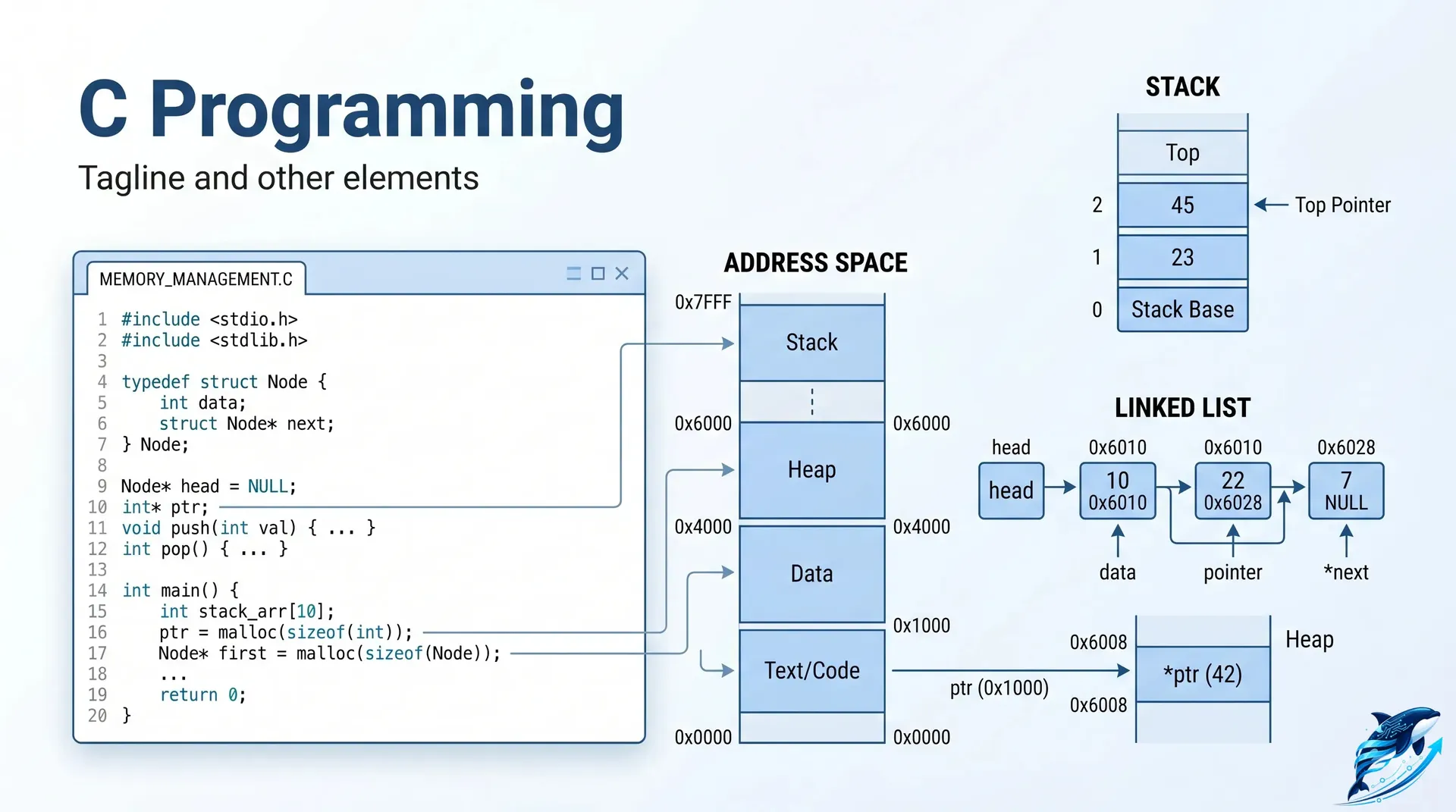
Master C Programming - The Foundation of Coding
Our Student C Programming Training is designed specifically for college students who want to build a strong foundation in programming. C is the mother of all programming languages and mastering it will help you understand memory management, pointers, data structures, and algorithms at a deeper level.
This course covers everything from C fundamentals, control structures, functions, arrays, strings, pointers, dynamic memory allocation, file handling, and data structures. With hands-on coding exercises, real-world projects, and placement assistance, you'll be ready for technical interviews and advanced programming courses.
Why Learn C Programming?
Foundation Language
C is the base for C++, Java, Python, and many languages
Memory Management
Learn pointers and dynamic memory allocation
Placement Ready
C is heavily tested in technical interviews
#include <stdio.h>

int main() {
    // Your first C program
    printf("Hello, World!");

    // Learn pointers
    int x = 10;
    int *ptr = &x;
    printf("Value: %d", *ptr);

    return 0;
}
Course Curriculum Student Special
Module 1: C Fundamentals
History of C, setting up compiler, variables, data types, constants, operators, and basic I/O functions.
Module 2: Control Structures
if-else, switch-case, loops (for, while, do-while), break, continue, and goto statements.
Module 3: Functions & Recursion
Function declaration, definition, parameters, return types, scope, storage classes, and recursion.
Module 4: Arrays & Strings
1D and 2D arrays, array operations, strings, string functions, and character handling.
Module 5: Pointers
Pointer declaration, pointer arithmetic, pointers with arrays, pointers to functions, and pointer to pointer.
Module 6: Dynamic Memory Allocation
malloc(), calloc(), realloc(), free(), and memory leak prevention techniques.
Module 7: Structures & Unions
Structures, nested structures, arrays of structures, unions, typedef, and enumeration.
Module 8: File Handling
File operations (create, read, write, append), file pointers, and binary files.
Module 9: Data Structures in C
Stack, Queue, Linked Lists (singly, doubly, circular), and basic sorting algorithms.
Module 10: Algorithms & Problem Solving
Searching (linear, binary), sorting (bubble, selection, insertion), and problem-solving techniques.
Projects You'll Build
Scientific Calculator
Advanced calculator with multiple functions
Student Management System
CRUD operations with file handling
Banking System
Account management and transactions
Inventory Management
Stock tracking with data structures
Snake Game
Classic arcade game in C
Contact Management
Linked list-based phonebook