Enterprise LangGraph Development Services in Lucknow
Build highly resilient, stateful, multi-agent AI systems. We architect cyclic workflows where AI agents collaborate, self-correct, and autonomously execute complex enterprise processes.
Stateful, Multi-Agent Collaboration
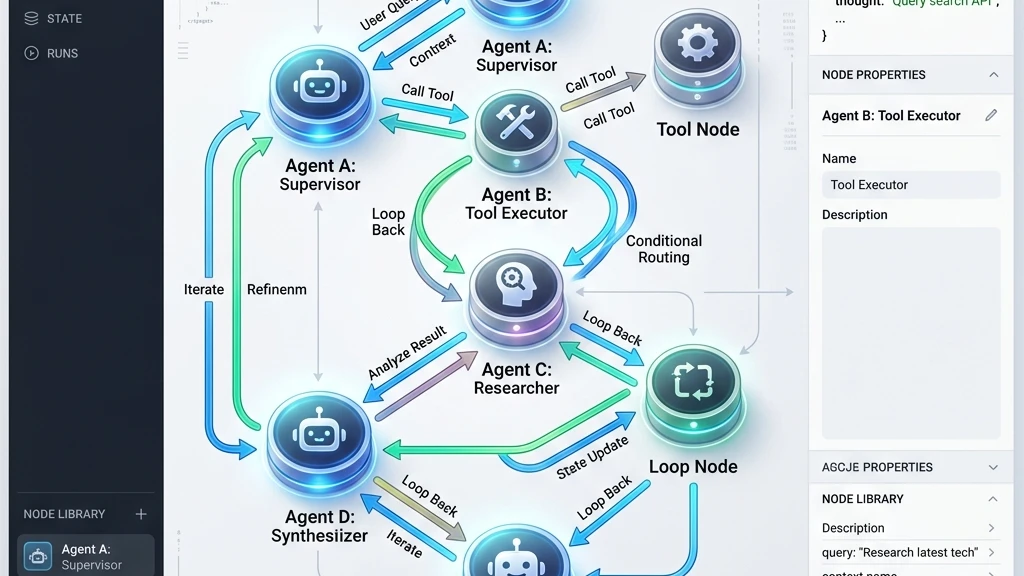
While standard AI applications follow a straight path, true autonomous systems require the ability to pause, reflect, loop back, and collaborate. LangGraph is the cutting-edge extension of LangChain designed precisely for this—building stateful, multi-actor workflows. At OrcaMinds, we engineer complex LangGraph architectures where specialized AI agents work together to solve deep enterprise problems.
Our experts build cyclic graphs that allow AI to perform a task (e.g., writing code), pass it to a reviewer agent, and if it fails, loop back to the original agent for corrections. We implement state persistence, human-in-the-loop checkpoints, and complex routing to deliver AI automation that is robust enough for production environments.
Why Manual Business Processes Stifle Growth
In today's competitive landscape, relying on manual data migration, copy-pasting, and email routing limits your ability to scale operations.
- High Operational Overhead: Employees spend valuable hours manually syncing spreadsheets, CRM records, and chat notifications.
- Frequent Administrative Errors: Manual data transfers lead to invoice billing anomalies, typos, and delayed communications.
- Slow Execution Times: Orders, leads, or support tickets wait in queues for hours waiting for manual approvals or assignment.
The Solution: Automated workflows trigger actions instantly across your apps (n8n/Zapier) in milliseconds with 100% data consistency.
The Brittleness of Linear AI Automation
Basic AI scripts execute linearly: Prompt, Retrieve, Generate. If the retrieval step grabs the wrong data, or the LLM generates a flawed answer, the entire process fails. There is no built-in mechanism for the AI to realize its mistake and try again, leading to fragile automation that requires constant human babysitting.
Furthermore, without state persistence, if an API call times out mid-process, the agent forgets its progress, resulting in wasted API costs and duplicated effort. Enterprises require architectures that are cyclic, self-evaluating, and state-aware.
Our LangGraph Development Capabilities
Cyclic Graph Workflows
Design non-linear execution paths. Agents can loop over tasks, refine outputs based on internal evaluations, and break out of loops only when strict quality criteria are met.
Multi-Agent Systems
Deploy specialized 'worker' agents managed by a 'supervisor' node. One agent researches, one writes, and one reviews, mimicking a real human department.
State Management & Persistence
Ensure fault tolerance. We configure database backends (SQLite/PostgreSQL) for LangGraph state persistence, allowing workflows to pause and resume perfectly.
Human-in-the-Loop (HITL)
Implement secure checkpoints where the AI halts execution to request human approval before executing high-stakes actions like sending emails or moving funds.
Dynamic Edge Routing
Program intelligent decision nodes that determine the next step in the graph based on the output of the previous LLM call, creating dynamic, unpredictable workflows.
Custom Tool Creation
Equip your nodes with custom Python functions, allowing agents to execute complex mathematics, run SQL scripts, or scrape deep-web data securely.
Our LangGraph Architecture Process
State Schema Design
We define the exact structure of the 'State' object—the global memory that will be passed and modified by every agent throughout the graph's execution.
Node & Agent Engineering
We build individual Python nodes representing specialized agents or functions, equipping them with highly specific system prompts and tools.
Graph Assembly & Routing Logic
We connect the nodes using conditional edges (routing logic), creating loops for error correction and setting up the human-in-the-loop pause points.
Execution & State Persistence
We compile the graph, attach a persistent database backend for memory retention, and deploy the system as an API endpoint for your enterprise to consume.
LangGraph Solutions in Production
Explore how our stateful architectures solve problems that standard, linear AI tools cannot handle.
1. Autonomous Web Research & Reporting
Market Intelligence Teams
Challenge: Analysts spend hours searching the web, evaluating sources, and compiling competitor pricing reports.
Our Approach: Built a LangGraph application where a 'Search Agent' scrapes URLs, passes data to an 'Evaluation Agent' to check relevance, looping back if the data is poor. Finally, a 'Writer Agent' compiles a structured PDF report.
Projected Impact: Reports that took 4 hours are generated autonomously in 3 minutes with higher source accuracy.
2. Self-Correcting Code Generation
Software Engineering
Challenge: Standard LLMs generate code that often fails syntax checks or lacks proper unit tests, requiring manual human debugging.
Our Approach: Deployed a cyclic graph. A 'Coder Agent' writes a Python script, an 'Execution Agent' attempts to run it in a secure sandbox. If it crashes, the error logs are routed back to the Coder Agent to fix, repeating until tests pass.
Projected Impact: Delivered 100% syntactically correct and verified code outputs directly to the repository.
3. Multi-Agent Customer Onboarding
Financial Services
Challenge: Onboarding required checking ID documents, querying credit bureaus, and drafting risk assessments across multiple departments.
Our Approach: Designed a supervisor agent that routes tasks. An 'OCR Agent' reads the ID, an 'API Agent' fetches credit scores, and a 'Risk Agent' evaluates. The workflow pauses for human approval before finalizing the account creation.
Projected Impact: Ensured zero compliance breaches while reducing manual processing time by 70%.
4. Continuous Data Auditing Agent
Data Operations
Challenge: Ensuring thousands of CRM entries were accurate and up-to-date was an impossible manual task.
Our Approach: Created an asynchronous LangGraph worker. It iterates through CRM rows, uses a web search tool to verify company details, updates missing fields via API, and logs its progress persistently in a SQLite database.
Projected Impact: A background process that runs 24/7, resulting in a perfectly clean CRM with no manual intervention.